
Developing innovative treatments: too slow, expensive and uncertain
Developing a new treatment remains one of the toughest innovation challenges there is.
A medicine can take more than 10 years to reach patients. Development costs often exceed $1 billion. And only around 8–10% of projects that enter development ever make it to market. Open innovation typically addressed this challenge: collaborate with external scientists to accelerate your internal drug development processes. See the example from Almirall (Almirall Share) in which we collaborate. Maribel Crespo, former R&D Alliances Director explained it very well.
But challenges (and opportunities) do not stop there.
Healthcare generates vast amounts of information, yet around 80% of healthcare data remains unstructured. Clinical trials are operationally complex. Recruiting patients remains difficult. And access to innovative treatments often depends on where patients live, which hospital they attend or how quickly regulatory processes move.
This is why AI investment has accelerated so dramatically in recent years. Here are a few examples:
- Sanofi expanded its collaboration with Exscientia in a deal worth up to $5.2 billion
- Eli Lilly expanded its partnership with Insilico Medicine in a deal worth up to $2.75 billion
- And Isomorphic Labs, the AI drug discovery company spun out of DeepMind, recently raised $600 million
The expectation is simple: if AI can reduce timelines, improve success rates or help treatments reach patients faster, the impact could be enormous in terms of patients quality of life and benefits for the industry too.
The enthusiasm is not limited to pharmaceutical companies.
The World Health Organization has repeatedly highlighted the potential of artificial intelligence to transform healthcare, accelerate research, strengthen health systems and improve patient outcomes. The organization has also launched multiple initiatives to help countries deploy AI responsibly and at scale.
Given the challenges outlined above, it is easy to understand why healthcare has become one of the sectors attracting the greatest AI investment worldwide.
Where AI is entering drug development
The first wave of AI adoption is happening in drug discovery itself.
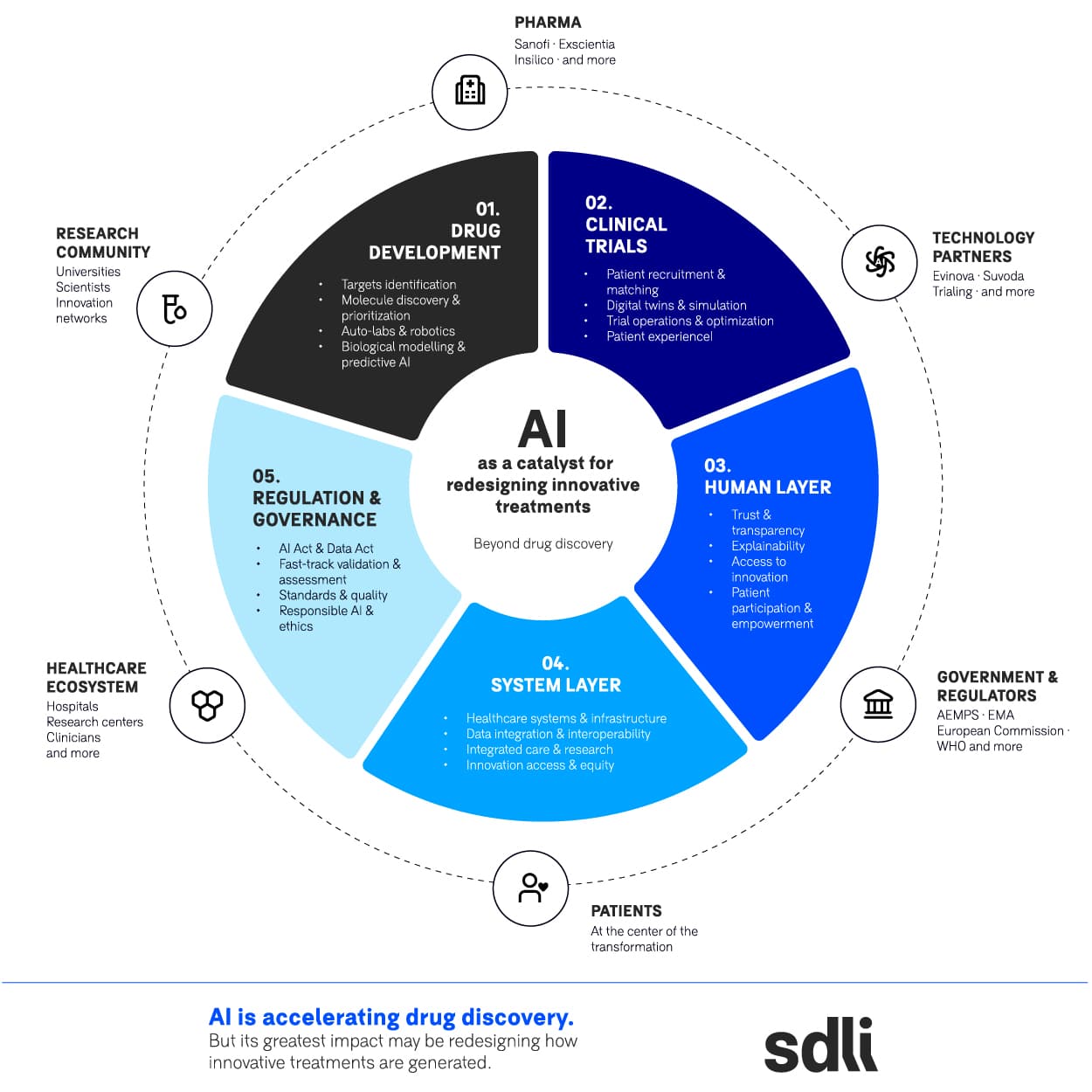
Researchers are using AI to identify biological targets, analyze scientific literature, explore genomic data and prioritize molecules that may have a higher probability of success.
Most of the value comes from predictive models, biological modelling and machine learning systems trained on large scientific datasets.
AI is helping researchers answer questions such as:
- Which proteins seem most relevant to a disease?
- Which molecules are worth testing?
- Which candidates are likely to fail?
- Which experiments should be run next?
The objective is not to remove scientists from the process. The objective is to allow scientists to test more hypotheses, learn faster and focus on higher-value decisions.
This shift is also changing R&D teams themselves. Pharmaceutical companies are incorporating new profiles and capabilities, but the challenge is not simply hiring more data scientists. As AI becomes more accessible, two factors may become increasingly important: the ability to identify and work with the right data, and the creativity required to formulate better questions, hypotheses and research pathways than competitors using similar technologies.
Sanofi has publicly discussed ambitions to accelerate parts of drug development by up to 50%.
The company is also exploring increasingly automated laboratory environments where AI and robotics help accelerate experimentation cycles.
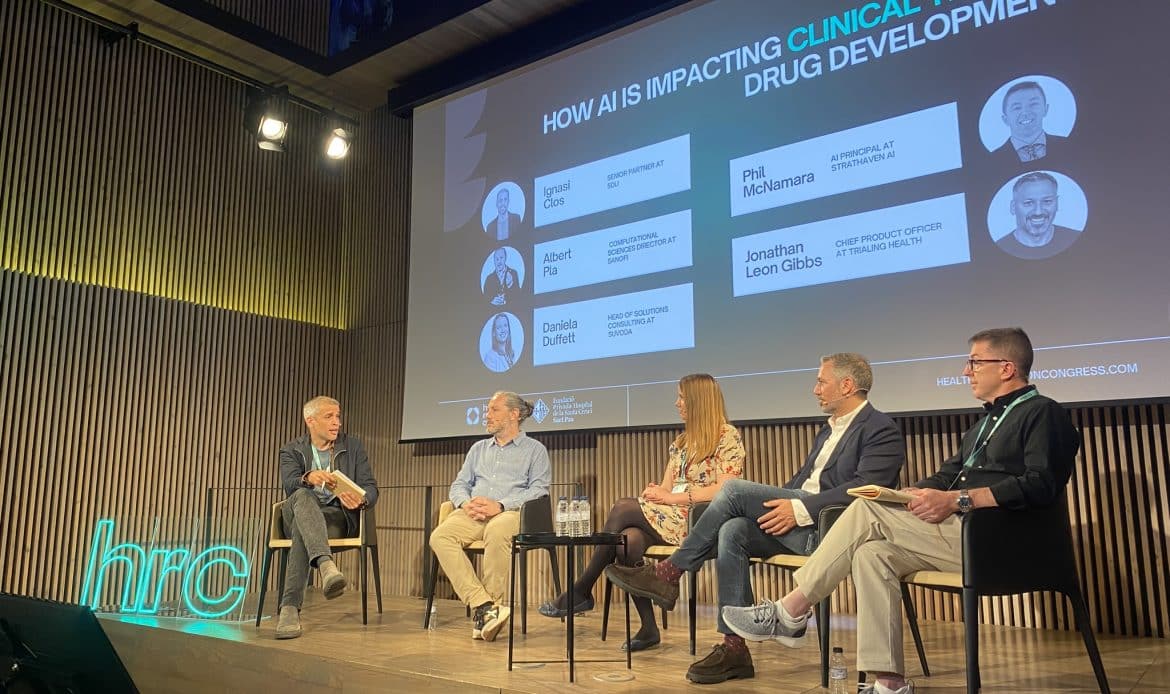
Albert Pla , R&D Data Science Director at Sanofi, explains some of these initiatives here. And this short video gives a glimpse of how Sanofi imagines the laboratory of the future: https://www.youtube.com/watch?v=bfUu3r3uVE0
Drug discovery remains fundamentally a biological challenge. But AI is becoming a powerful tool for navigating that complexity.
“AI is augmenting how scientists work, allowing us to test hypotheses and identify knowledge gaps at much faster speed. But its impact is limited if we don’t adapt our ways of working. The real transformation isn’t in the models but in how we organize ourselves to take advantage of them”, says Albert Pla.
Where AI is entering clinical trials
But finding a promising molecule is only part of the journey.
Clinical trials remain one of the most expensive, time-consuming and operationally difficult stages of healthcare innovation.
This is where a second wave of AI adoption is taking place.
One obvious example is patient recruitment: finding eligible patients often takes longer than expected and delays many clinical studies.
AI can help identify potential candidates, analyze eligibility criteria and improve matching between patients and studies.
Other applications focus on protocol design, site selection and trial operations.
Researchers are also exploring digital twins and synthetic patient populations to improve trial design and simulate potential outcomes before studies begin.
Sanofi has published several perspectives on how digital twinning could reshape clinical research.
At the same time, a growing number of companies are focusing on the operational side of clinical research.
Suvoda, a clinical trial technology company that provides end-to-end software for study operations, finance, and patient engagement, is applying AI to the parts of the study that have historically slowed down trials. Their AI innovations are making it easier for sponsors, CROs, and sites to run their trials with speed and confidence
“AI can help clinical teams move faster without taking human judgment out of the process. At Suvoda, we’re applying agentic AI to randomization and trial supply management (RTSM) to accelerate the slower parts of study setup. Sofia, our AI assistant, helps site teams get quick visibility to study status once a trial is running. In clinical research, AI must include the safeguards, traceability, and auditability our regulated industry requires. That’s the bar we hold ourselves to: a practical and thoughtful use of AI that can reduce manual work, keep experts in control, and give sponsors, CROs, and sites more time to focus on the decisions that shape trial execution.” says Daniela Duffett, Head of Solutions Consulting, eClinical Services at Suvoda
Human layer: language, trust and access
But healthcare is not only a scientific challenge.
As AI becomes more visible across healthcare, questions around trust become increasingly important.
Patients need to understand:
- how their data is being used,
- who remains responsible for decisions,
- and how these systems may affect their care.
Another important question is access.
Today, many patients never hear about clinical trials that could potentially benefit them.
Organizations such as Trialing are trying to address that gap.
Their work focuses on connecting oncologists, hospitals and patients with relevant clinical trial opportunities and integrating research more naturally into routine care.
The idea is simple: clinical research should not feel like a parallel universe. Systems apart.
“It should become a more natural extension of routing patient care.”, says Jonathan Gibbs, Chief Procut Officer at Trialing.
Recent reviews suggest that AI-supported trial matching and referral systems could help improve access and reduce participation barriers.
And several publications already reference platforms such as Trialing as examples of this emerging approach.
System layer: Spain, Europe and the role of government
The transformation is not being driven only by pharmaceutical companies and technology providers.
Governments and regulators are becoming increasingly important actors.
Spain is an interesting example.
The country has become one of Europe’s leading locations for clinical research, with more than 900 clinical trials authorized in 2024.
At the same time, Spain continues to face challenges in translating scientific activity into healthcare innovation and patient access.
These are some of the reasons why the Spanish Medicines Agency (AEMPS) is working on initiatives aimed at accelerating assessment processes for innovative medicines and clinical trials.
At the European level, the conversation is also evolving: the AI Act and the Data Act will shape how AI systems are governed, validated and deployed across healthcare environments.
As technology accelerates, institutions need to evolve as well. Otherwise, the bottleneck simply moves from research to regulation.
«What happens in the laboratory is only half the story. AI in drug development will only deliver at scale if the governance frameworks, regulatory pathways and health system infrastructure keep pace. Europe is asking the right questions — the challenge now is answering them fast enough to matter for patients«, informs Phil McNamara, strategic AI consultant in the life sciences industry.
Conclusions: AI as a catalyst for a larger transformation
AI is helping researchers discover molecules.
It is helping clinical teams run studies.
It is helping identify patients and improve trial operations.
And it is also forcing critical conversations about access, infrastructure, regulation, interoperability and trust.
That may be its most important contribution.
The technology triggers a deeper transformation that touches science, healthcare systems, regulation, patient experience and the way innovation itself moves through the system.
And that is probably why so many organizations are investing so heavily in it.